
Brain Health in the older adult: between frailty and resilience. Dr. Domenico Pratico', MD, FCPP

Brain health is a state of physiological functioning of the brain that allows individuals to fully realize their potential for each age group.
It refers to the different functional aspects of the brain, which, working together, ensure harmonious and optimal functioning of this organ.
These include cognitive functions, which relate to memory, the ability to learn new information, perform tasks, and solve problems. Sensory functions, which involve the various senses such as touch, smell, and hearing, and the ability to integrate this information with the external environment and our body. Motor functions, which ensure the ability to make coordinated and harmonious movements in performing a specific task. Social and behavioral functions, which underpin our relationships with other members of the community—those around us, from family to the workplace or recreational settings.
Finally, the emotional functions responsible for emotional well-being, which include emotions, feelings, but also reactions to pleasant or unpleasant situations, and acute and chronic stress and how we cope with it.
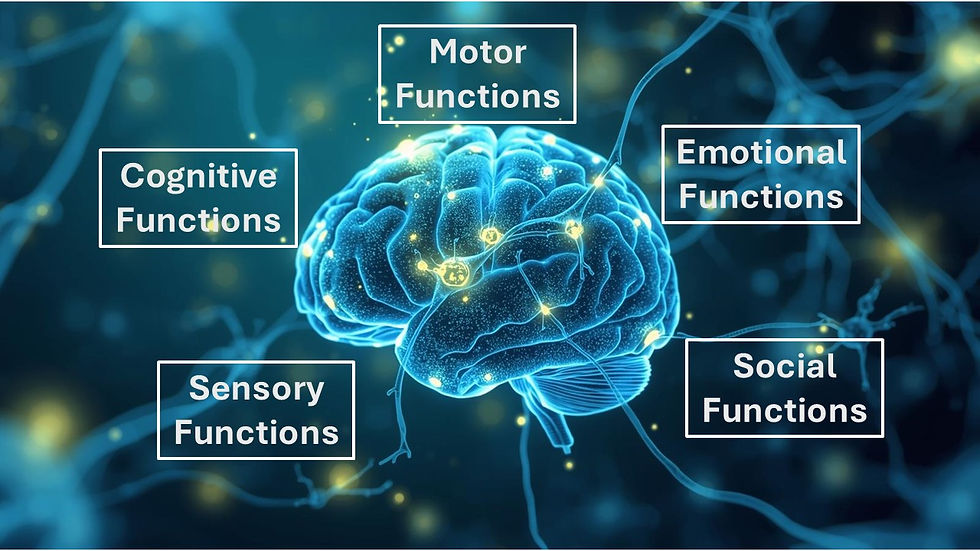
Brain health is not a static condition but a dynamic one, as various factors can influence it throughout life, both positively and negatively. This aspect, while very important for brain health, also highlights the organ's frailty.
Among the various factors that have a strong impact on brain health and its frailty, first and foremost is age, or aging, which is undoubtedly one of the most important, particularly on cognitive function.
In fact, cognitive abilities peak around age 30-40 and typically decline gradually with advancing age, but significantly starting at age 60. Normal age-related cognitive decline primarily affects thinking speed and attention, but the individual's independence is always preserved. Pathological cognitive decline, however, affects multiple areas and results in short-term memory loss, difficulty solving common problems, and impaired verbal expression, all of which impair the individual's independence.
From a clinical perspective, cognitive decline is not a uniform process, nor does it always follow a linear trajectory.
In this regard, we can distinguish three main pathways of cognitive decline in the elderly. The first, considered physiological, manifests with a minimal reduction in cognitive abilities, which on average reaches a level less than or equal to 5-8% of normal.
In others, however, it follows a different path, decreasing by up to 20%. In these cases, we speak of "mild cognitive impairment."
Finally, there are cases in which this reduction can reach 30-35% of normal; in these cases, we are dealing with "dementia."

Worldwide, approximately 60 million people currently suffer from dementia. When we talk about dementia, we often refer to its most common form, Alzheimer's disease, which accounts for approximately 65% of all dementia cases. Although the exact causes of dementia are unknown, we now know that there are risk factors that, if present in an individual, increase their likelihood of developing it.
There are two types of risk factors: modifiable and non-modifiable.
Non-modifiable risk factors include age, gender, and genetic factors such as apolipoprotein E4 (APOE4).
Modifiable risk factors include certain metabolic diseases of middle age, such as non-insulin-dependent diabetes mellitus, hypertension, hypercholesterolemia, and obesity. There are also modifiable lifestyle factors, such as diet, smoking, physical inactivity, and social isolation.
Given all this knowledge, the question we must ask is:
“Is it possible to intervene on these risk factors with the aim of improving brain health, preventing pathological cognitive decline, and building brain resilience?
The answer is "yes, we can."
Today we know that up to 45% of dementia cases could be prevented or delayed by addressing these modifiable risk factors. These factors affect a person's entire lifespan, from early education to cardiovascular health and socialization in later life—what we often call the exposome.
Supported by this knowledge, our group recently launched a general awareness campaign through our websites to promote the “ Brain Health Compass ” and its 4 cardinal points, which provide a framework for anyone who wants to achieve healthy brain aging, preserve brain health, increase cognitive reserve, and build brain resilience.

NORTH . Nutrition. Numerous clinical studies have shown that a healthy diet reduces the incidence of dementia, the risk of dementia, and the number of dementia-related deaths. It is imperative to follow a healthy diet like the Mediterranean diet. Avoid red meat, added sugars, processed foods, and saturated fats because they increase the risk of cognitive decline and dementia.
EST . Daily physical Exercise. Physical activity has enormous benefits for our cardiovascular health. Recent studies have shown that this regular regimen of daily physical activity also has a positive effect on brain health. You don't need to commit to a structured exercise routine, like going to the gym, to stay fit and healthy. There is a simple yet effective solution that can still offer excellent benefits for brain health and cognitive reserve: walking every day for at least 30 minutes or taking 5,000 steps a day.
SOUTH. Socialization and the stimulation of cognitive activities (book clubs, gardening, group sports, etc.). Maintaining an active social life helps ward off the negative health effects of social isolation. Studies have shown that social isolation is associated with abnormal brain structure and activity in several regions, including the prefrontal cortex and hippocampus. Poor social relationships and isolation increase the risk of developing dementia by 50% not only in older adults but also in young adults.
WEST. WELL-BEING. We must intervene early on modifiable risk factors for pathological cognitive decline and dementia including type 2 diabetes, obesity, adult-onset hypertension, and smoking. By adopting simple lifestyle changes, such as correcting high glucose levels, losing weight, controlling blood pressure, and quitting smoking, we can promote brain health, increase cognitive reserve, brain resilience, and dramatically reduce the incidence of pathological cognitive decline and the risk of dementia.
And as I always say, keep in mind that it is never too early and never too late to follow the 4 Cardinal points of healthy behavior.
If you are interested in reading more of my blogs:
Domenico Praticò, MD, is a Professor of Pharmacology, Immunology, Microbiology and

Neural Sciences. He the Founding Director of the Alzheimer Center at the PraticoLab.
For more information on the research conducted by Dr. Domenico Pratico, please visit this link.
Connect with Dr. Domenico Pratico through LinkedIn, Facebook, Twitter, Medium.
Stay updated with the work happening at Dr. Domenico Pratico's lab by visiting the Pratico Lab website.


Comments